

Review · GERMANY
Munich: Self-guided sightseeing scavenger hunt for families
Munich’s Lili and Oskar scavenger hunt turns sightseeing into a family game. You follow eight envelopes through the city centre, solving puzzles and completing small tasks while learning about Bavarian life, local expressions, famous rulers, and Munich’s sights. It feels less like a formal tour and more like a city walk with a story tucked inside a metal box.
I especially like the freedom to set your own pace and the route’s practical finish at Viktualienmarkt, where you can stop for food after the final puzzle. The mascots also give the activity a warm local voice. The main caution is language: everything is in German, and some reading may feel too long or dry for younger children.
Key points to know
- Eight envelope-based stations: Open each envelope only when you reach the correct stop, then follow the clues to the next place.
- Start at the Hofgarten: The walk begins in central Munich, with the option to make a detour toward the English Garden.
- Finish at Viktualienmarkt: The famous food market gives your family an easy place to eat and talk over the game.
- Lili and Oskar lead the way: These illustrated Munich mascots explain local customs, Bavarian dialect, and city facts.
- Plan for German reading: The puzzles and instructions are child-friendly in tone, but the entire activity is in German.
- Best value for a group: At $47 for up to eight people, the cost is strongest when shared by a family or larger group.
How the Munich box turns sightseeing into a game
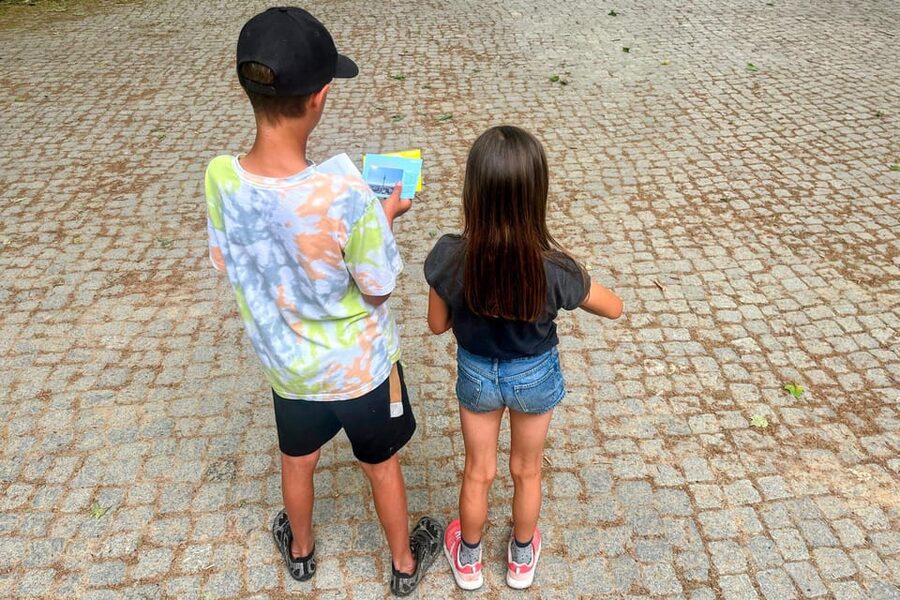
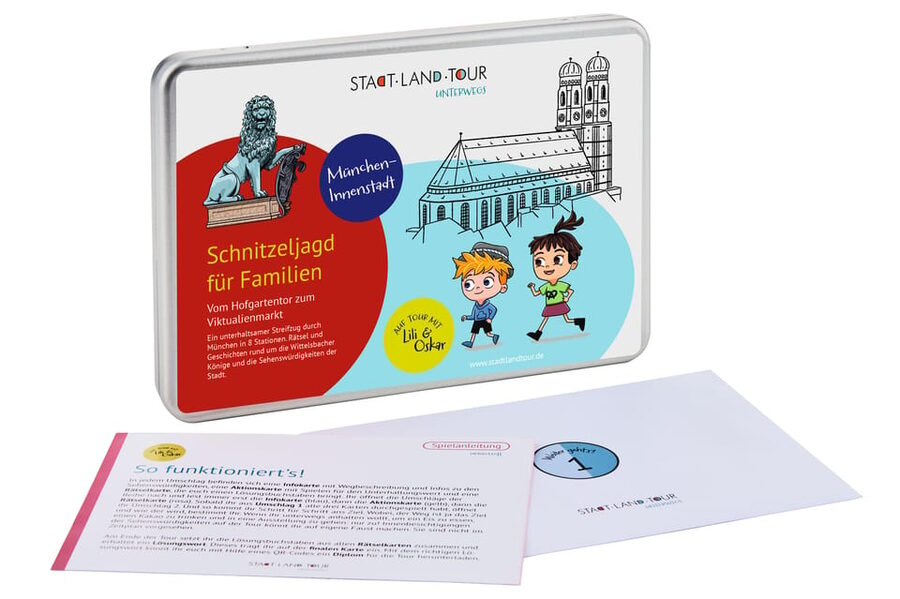
The heart of this experience is a sturdy metal box filled with maps, envelopes, illustrations, instructions, puzzles, and a small surprise for the end. You bring a pen, open the first map, and travel to the starting point. At each stop, you open the next envelope and find information about the sight, along with a task that keeps the walk moving.
That order matters. You are not handed the entire route at once, so children have a reason to pay attention to street signs, buildings, and clues. The next envelope becomes a small reward. It also gives the day a simple rhythm: walk, read, solve, move on.
Lili and Oskar are the voices behind the route. They are presented as two Munich natives, with playful illustrations and local jokes. Their job is not just to point out monuments. They explain bits of Bavarian character, city life, and dialect in a way that families can share.
I like this approach because a child does not need to care about architecture before starting. The game gives a reason to look closely. Adults get background information, while children get a challenge to solve. That said, the reading is not all light and quick. One clear weakness is that parts of the text can be too long or too dry for children, so parents may need to shorten explanations or read them aloud with a little energy.
More Scavenger Hunts in Germany
- Hamburg: Scavenger Hunt Self-Guided Tour for Children
★ 4.5 · 319 reviews - Dresden: Old Town Self-Guided Scavenger Hunt Tour
★ 4.5 · 151 reviews - Escaping and spying on the Berlin Wall Scavenger hunt
★ 4.5 · 128 reviews
Starting at the Hofgarten and finding your bearings
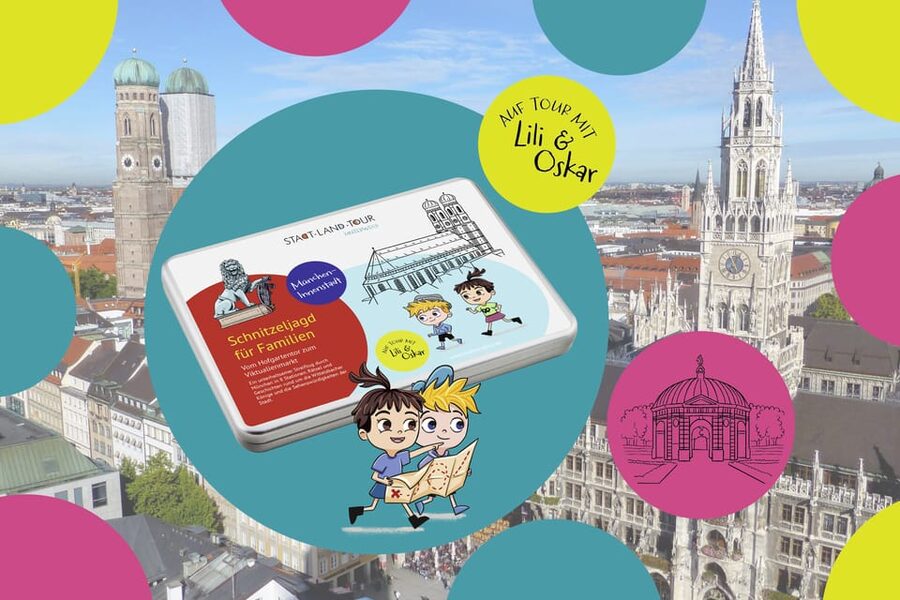
The route begins at the Hofgarten, a central Munich park that makes a sensible meeting point for a self-guided activity. You do not meet a guide there. The first map in your box gives the starting directions, so you can begin at the time that suits your family.
This is one of the strongest features of the tour. If your child needs breakfast, a rest, or an early lunch, you are not holding up a group. You can start when everyone is ready. The stated tour time is 150 minutes, but that is best treated as the playing time rather than a strict appointment.
The Hofgarten also leaves room for a detour toward the English Garden. The route does not force you to make that side trip, which is useful if you have already visited the park or if small legs are running out of energy. You decide if the extra stop fits your day.
The first envelope sets up the activity and explains what to do next. You should resist the temptation to open every envelope at once. The fun depends on discovering the clues in sequence, and the box includes a solution envelope only for times when your family gets stuck.
Munich’s centre, one envelope at a time
The exact stops are kept partly as a surprise, but the route moves from sight to sight through Munich’s centre before ending at Viktualienmarkt. You can expect a mix of well-known places and details that are easy to miss on a standard walk.
At each station, the material has three jobs:
- Explain the attraction in accessible language
- Give you a puzzle or creative activity
- Point you toward the next stage
That combination keeps the walk from becoming a string of short lectures. You may need to search for a detail, discuss an answer, or work together on a task. The activity is designed for the whole family, not just for children who already enjoy history.
The information also reaches beyond buildings. Lili and Oskar introduce local habits, Bavarian words, and small facts about the people of Munich. You may not come away speaking Bavarian, but you will pick up some local flavour and a better sense of how the city presents itself.
Because this is self-guided, you control the pace at every stop. If a sight catches your eye, you can pause. If one explanation loses the children, you can move on. This flexibility is a genuine advantage over a fixed walking tour, especially for families with different attention spans.
The tradeoff is that there is no live game master to adjust the activity on the spot. If an answer causes confusion, you rely on the built-in hints and solution envelope. Families who enjoy working things out together will like that independence. Families wanting a guide to answer questions immediately may find the format less satisfying.
The value of the bonus stops
The route includes suggestions for places you pass along the way that are not part of the main hunt. These can include a museum, playground, park, or another interesting stop. You decide if you want to pause the game and visit.
This is more useful than it may sound. A family city walk rarely follows a perfect schedule. One child may need a toilet break, another may spot a museum, and everyone may want an ice cream. The activity allows you to treat those interruptions as part of the day rather than as problems.
You should still budget for extra costs. Museum admission is not included, and neither are food, drinks, public transport, or bus and train tickets. The hunt gives you suggestions, not entrance tickets or transport. If you plan a museum visit, check its price and opening arrangements separately.
The bonus system also helps you avoid a common family-tour problem: rushing past a good place because the itinerary is too rigid. Here, the game can pause and restart. You can finish the full hunt in one stretch, or make it one piece of a wider Munich day.
More Self-Guided Games in Germany
- Berlin: Self-Guided Family and School Class Scavenger Hunt
★ 4.6 · 128 reviews - Düsseldorf: Scavenger Hunt Self-Guided Tour
★ 4.6 · 127 reviews - Leipzig City Centre: Scavenger Hunt Self-Guided Tour
★ 4.4 · 114 reviews - Weimar: Scavenger Hunt Self-Guided Walking Tour
★ 4.3 · 108 reviews
From city sights to Bavarian stories
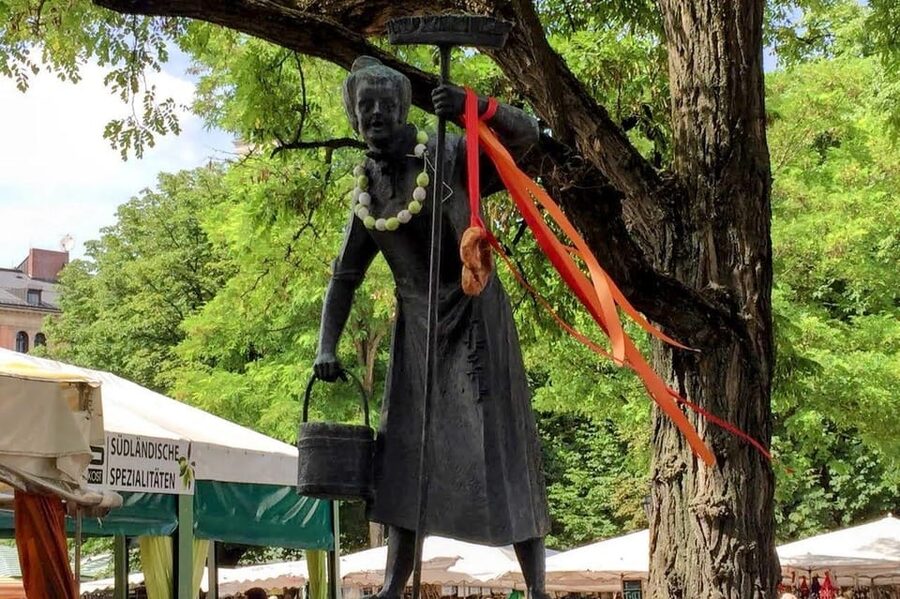
The educational side works best when you want your children to learn without sitting in a museum for hours. The material covers Munich, Bavaria, local people, famous kings, and regional history. It also explains local information for people who are not from Bavaria, so you do not need prior knowledge to follow the clues.
The mascots make a difference. Lili and Oskar are not presented as dry historical figures. They use jokes, illustrations, and dialect to make the material feel local. Some jokes may land better with adults than children, but the tone gives the box personality.
I would expect the youngest children to need help with reading and solving. The activity is described as family-friendly, not as a game that young children can complete alone. Older children who can read German will get more independence, while parents can keep the pace moving and explain unfamiliar words.
The German-only format is the biggest deciding factor. If your family does not read German, this is not a suitable choice. Translation apps might help with a few phrases, but they would slow the game and remove much of the point. The puzzles, instructions, jokes, and local language are designed to work together in German.
Ending at Viktualienmarkt
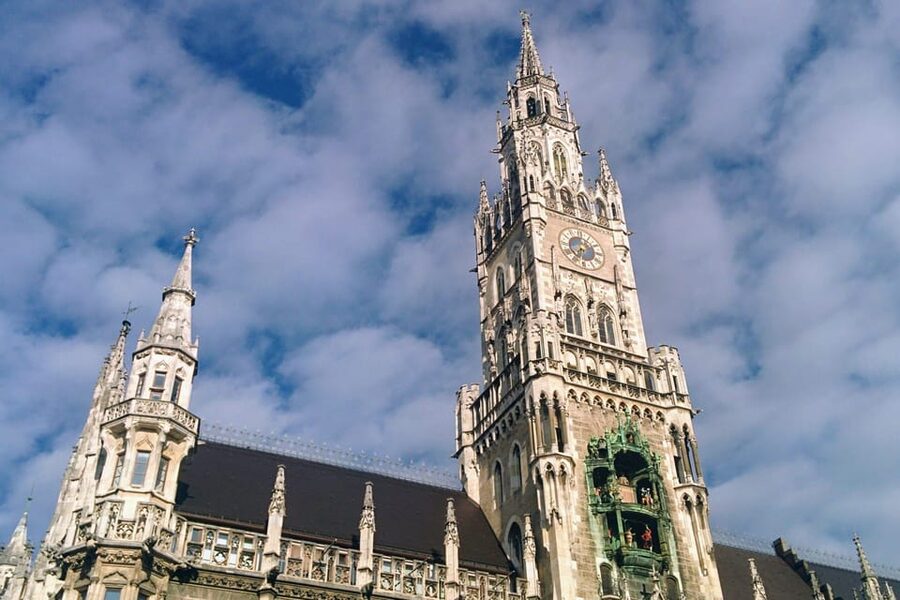
The finish at Viktualienmarkt is a smart choice. After about two and a half hours of walking and solving, you arrive at one of central Munich’s natural places for a snack or meal. You can compare answers, talk about the best station, and use the market as a relaxed ending rather than having to find a restaurant elsewhere.
The final envelope contains a small surprise, provided you have solved the puzzles and found the solution word. If your family gets stuck, help is available along the route, so the ending is not meant to punish anyone who misses a clue.
This is also where the self-guided format pays off again. You can finish the game and eat right away, or continue exploring. Nothing requires you to leave the area at a fixed time.
The food at Viktualienmarkt is not included in the $47 price, so keep money aside for refreshments. Still, ending near a place with many food options makes the cost easier to judge. You are paying for the prepared game and route, not for a meal or admissions.
Is $47 good value for a family?
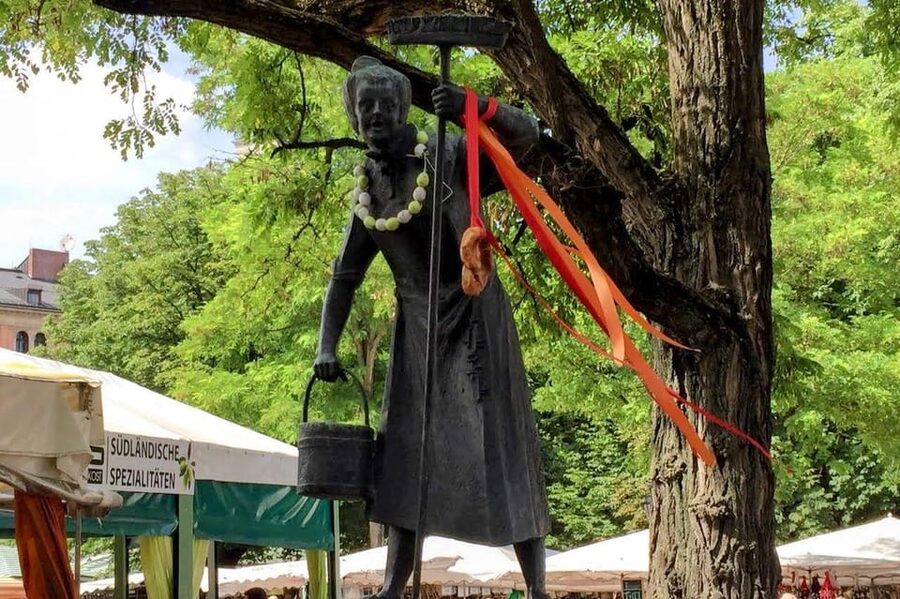
The price is $47 per group of up to eight people. For a family of four, that works out to less than $12 per person. For a full group of eight, it becomes very good value. For just one or two people, the price is harder to justify, since the game depends on shared solving and family participation.
You also receive a physical product: a high-quality metal box, eight envelopes, maps, puzzles, illustrations, hint material, a final envelope, and a small surprise. The box is mailed to you, either at home or to your hotel or holiday flat in Munich. Within Germany, delivery usually takes at least two to four working days, so you should order well before the day you want to play.
The price does not cover a guide, local transport, museum entry, or meals. That keeps the base cost clear, but you need to plan those extras yourself. You also need to supply your own pen and wear comfortable shoes.
I see the best value for families who want an activity that occupies a substantial part of an afternoon without booking a guide. You are buying flexibility as much as sightseeing. If you prefer a professional guide who talks while you walk, spend your money elsewhere. If your family likes clues, jokes, and a shared task, the price is reasonable.
Who should choose this Munich activity?
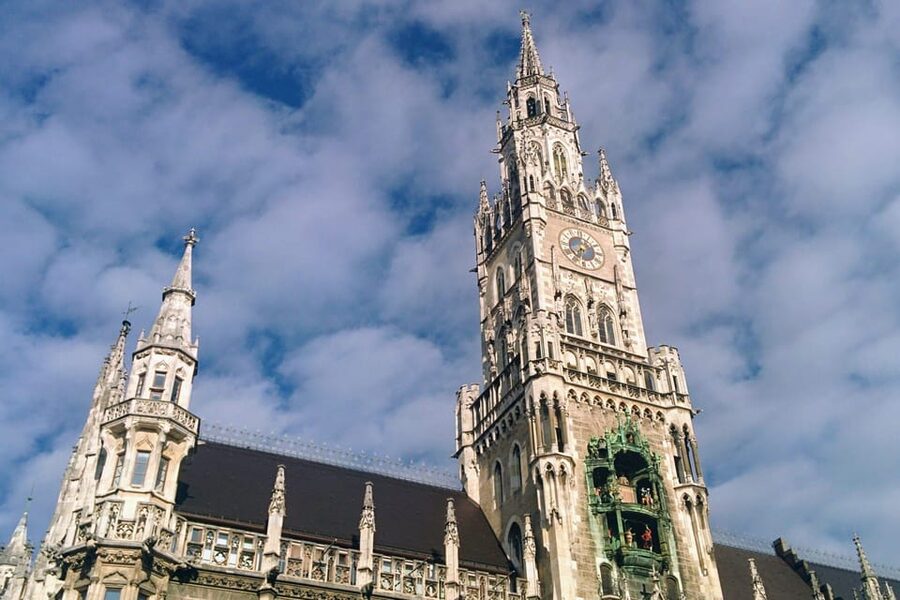
This hunt suits families with children who enjoy puzzles, reading, and small challenges. It is also a good match for parents who dislike rigid schedules. You can stop for a museum, park, playground, or ice cream without losing the whole day.
It may work especially well as a first Munich activity because the route introduces major city sights while giving you useful local context. You get an orientation walk, but the game keeps it from feeling like a basic list of monuments.
I would be cautious if your children tire quickly from walking or dislike reading. The full route takes about 150 minutes, and the text can occasionally feel too lengthy for children. You can simplify the material and use the solution envelope, but that requires a parent to manage the experience.
The activity is also not a fit for non-German speakers. The information and puzzles are entirely in German, and the dialect is part of the charm. This is a German-language product first, not an international tour with optional German content.
Practical details before you order
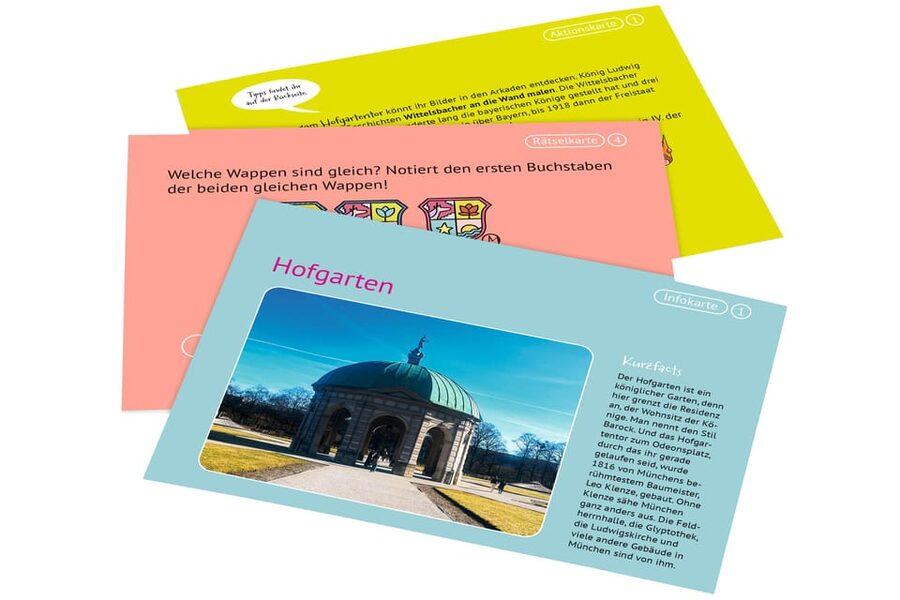
You can start at any time because there is no guide waiting at the meeting point. The directions are inside the box, and the route begins at the Hofgarten and ends at Viktualienmarkt.
Allow more than the stated 150 minutes if you plan to make a detour, eat, visit a museum, or let children take breaks. The time is a useful guide, not a race. Comfortable shoes are important, and you should carry the box and a pen with you.
The box must be ordered online and sent by post. Enter a complete shipping address, and if you send it to a hotel or holiday flat, tell the hotel desk or property manager to expect it. A delayed box would spoil the plan, so delivery timing deserves attention.
You can cancel up to 24 hours in advance for a full refund, and the reserve-now, pay-later option can help if your schedule is still changing. Check the available start arrangements when booking, even though the actual game lets you begin at your convenience.
Should you book the Lili and Oskar hunt?
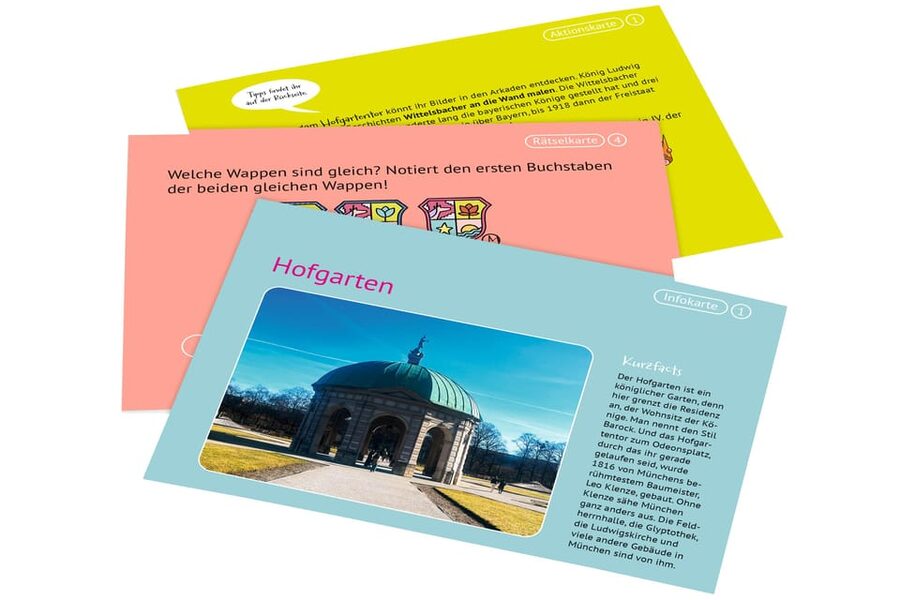
Book it if you want a flexible family walk in German with puzzles, local jokes, and room for spontaneous stops. The free scheduling, central route, eight envelopes, and Viktualienmarkt finish make it easy to fit into a Munich day. The $47 group price is fair, especially for four or more people.
Skip it if you need English, a live guide, or a fast-moving activity with little reading. The texts may be too dry for some children, and museum tickets, transport, and food cost extra.
For German-speaking families who like solving things together, this is a thoughtful way to see central Munich without dragging everyone through a formal lecture. Pack a pen, leave room in your schedule, and let Lili and Oskar set the pace.
FAQ
How long does the Munich scavenger hunt take?
The stated duration is 150 minutes. You can take longer if you pause for food, ice cream, a museum, a playground, a park, or a detour toward the English Garden.
Where does the scavenger hunt start and finish?
The route starts at the Hofgarten in Munich city centre and ends at Viktualienmarkt. Directions to the starting point are provided inside the scavenger hunt box.
Is the activity available in English?
No. The scavenger hunt is entirely in German, including the information, puzzles, jokes, and local dialect.
What is included in the scavenger hunt box?
The box includes eight envelopes, maps, instructions, puzzles, illustrations, child-friendly information, hints, a solution envelope, a final envelope, and a small surprise. It is sent by post.
Do I need to bring anything?
Bring a pen and comfortable shoes. You should also carry the game box with you during the route.
Are museum tickets and public transport included?
No. Museum admission, bus and train tickets, food, and other personal expenses are not included.
More Family and Kids Games in Germany
- Dresden: Old Town Scavenger Hunt for Children
★ 4.6 · 117 reviews - Leipzig: Scavenger Hunt Self-Guided Tour for Children
★ 4.4 · 105 reviews - Munich: Scavenger Hunt Self-Guided Tour for Children
★ 4.5 · 101 reviews - SAMS Kids’ Puzzle Tour with Puzzle Backpack through Bamberg
★ 4.6 · 15 reviews
New puzzles around Germany
- Self Guided Scavenger Hunt and Tour in Heidelberg★ 4.0 · 7 reviews
- Heidelberg Scavenger Hunt and Highlights Self Guided Audio Tour★ 4.0 · 9 reviews
- Heidelberg Self Guided Sherlock Holmes Murder Mystery Game★ 5.0 · 3 reviews
- Störtebeker city puzzles in Hamburg with the smartphone★ 5.0 · 5 reviews
- Adventure Breakfast and Escape Game in Braunschweig★ 4.5 · 2 reviews
- Hamburg Scavenger Hunt and Sights Self-Guided Tour★ 4.5 · 10 reviews
- e-Scavenger hunt Hamburg: Explore the city at your own pace★ 4.0 · 4 reviews
- Hamburg Scavenger Hunt and Highlights Self Guided Audio Tour★ 4.5 · 10 reviews
Family and Kids Games, head to head.



Greek Mythology Treasure Hunt for Kids – Athens Private Tour
Read our review →

Private Venice Family Tour with Saint Mark’s & Doge’s Palace
Read our review →Other lists this game appears in