
Review · CHICAGO
Eastside Chicago The Heist Exploration Game and Tour
Chicago’s Eastside Heist is part sightseeing walk, part puzzle game, and part crash course in public art. You move from the Art Institute of Chicago through Millennium Park and Grant Park, solving challenges tied to sculptures, fountains, gardens, and landmarks. The price is just $7.20 per person, which makes it an inexpensive way to add structure to a walk through the Loop.
I like the freedom to start at any hour, pause for lunch or photos, and continue later. I also like that the game works offline, since you are not forced to keep searching for a signal while standing under the skyline. The main drawback is that the app depends on location range and clear access to each stop. Construction or a blocked path can turn a simple clue into a frustrating one.
Key points before you book
- A self-guided route through Chicago’s best public art: You visit Cloud Gate, Crown Fountain, Buckingham Fountain, Lurie Garden, and several lesser-known monuments.
- A low-cost private activity: At $7.20 per person, the game is priced more like a casual attraction than a traditional guided tour.
- About 1 hour 35 minutes of walking: Comfortable shoes matter, and the route may feel longer if you stop often for photos.
- Offline play with flexible timing: Start anytime, pause whenever you need, and resume later without an internet connection.
- No guide or group commentary: Your phone gives you the clues and information, so the experience suits independent explorers more than visitors seeking live interpretation.
- App access can affect the game: Construction, blocked areas, or difficulty getting within range of a fountain may require hints or an expanded radius.
The route begins at the Art Institute on Michigan Avenue
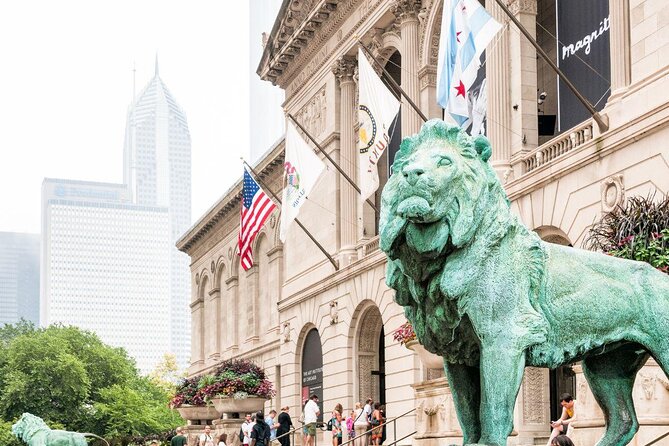
Your starting point is 111 South Michigan Avenue, outside the Art Institute of Chicago. This is a strong place to begin because the museum is more than a famous collection of paintings. It was founded in 1879 as both a museum and an art school, during the period when Chicago was rebuilding after the Great Fire of 1871.
The game asks you to look around and find an answer before moving on. That simple format changes how you see the street. Instead of walking past the museum entrance on the way to Millennium Park, you are asked to notice details and connect the setting to Chicago’s civic story.
The activity does not include museum admission, and there is no physical guide leading you inside. You should think of the Art Institute as an outdoor starting point and historical reference, not as a museum visit.
Just outside the museum, the Chicago Stock Exchange Arch gives the route a useful architectural twist. It is one of the few remaining pieces of the 1893 Chicago Stock Exchange building. The fragment now sits near the Art Institute, where it offers a direct link to the city’s late nineteenth-century architecture.
I like this opening because it starts with more than the obvious sights. You get a look at Chicago’s art culture, its rebuilding after the fire, and a surviving piece of a vanished building before the game moves toward the park.
More City Exploration Games in the USA
- Haunted Chicago Exploration Game and Tour
★ 4.0 · 6 reviews - San Francisco Haight Ashbury Hippie Exploration Game
★ 4.5 · 13 reviews - San Diego: Balboa Park Botanical Exploration Game
★ 4.5 · 12 reviews
Calder’s Flying Dragon adds a bold red-orange clue
One stop focuses on Alexander Calder’s Flying Dragon. The stainless steel sculpture is coated in the artist’s familiar red-orange color, the same strong hue he used for Flamingo near Chicago’s Federal Plaza.
Calder worked across roughly fifty years, and this stop gives you a small introduction to his public art without requiring a museum ticket. The challenge asks you to inspect the work and its surroundings. That can be more interesting than simply reading a plaque, especially if you are playing with children or friends who enjoy finding visual details.
The game format also helps break up the walk. You are not only moving from one famous point to another. Each stop gives you a reason to pause, look closely, and discuss what you see.
Crown Fountain turns public art into a social stop
Crown Fountain is one of Millennium Park’s most recognizable works. Designed by Spanish artist Jaume Plensa and built with Krueck and Sexton Architects, it opened in July 2004.
The fountain combines video imagery with water and public space. It is a very different experience from a traditional statue or monument, and it shows how Chicago uses modern art in places where people gather, sit, walk, and play.
The challenge here asks you to search the area for an answer. That works well at Crown Fountain because the artwork rewards observation. At the same time, water and crowds can make it harder to get close to the exact point the app expects. Keep that in mind if you are trying to complete every challenge without using hints.
Cloud Gate is the route’s biggest crowd magnet

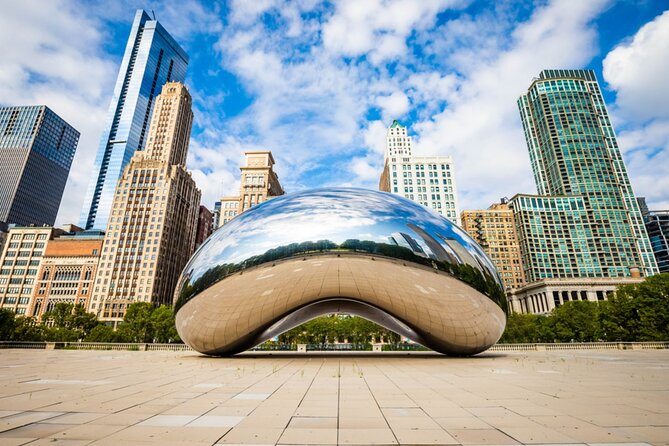
Cloud Gate, often called The Bean, is the most famous stop on the route. British artist Anish Kapoor created it as his first public outdoor work in the United States. The 110-ton sculpture is made from polished stainless steel plates joined into a smooth, reflective form.
You will see the skyline, clouds, and people bend across its surface. The work is simple to understand at a glance, but the game gives you a reason to examine it more carefully.
Cloud Gate is also the point where timing matters most. The sculpture is a popular photo stop, and you may need patience to move around it and find the detail required for the challenge. The route does not promise a quiet visit, so plan for a public space with plenty happening around you.
I like that the game places such an iconic work alongside smaller and less familiar pieces. You get the classic Chicago photo, but the route does not stop with the city’s most photographed object.
More Heist and Spy Games in Chicago:
- Bank Heist Escape Room Game for Private Group
★ 5.0 · 519 reviews - Undercover City Games: Gdansk
★ 5.0 · 198 reviews - Undercover City Games: Poznan
★ 5.0 · 88 reviews - Downfall Spy Mission (Premium Private Escape Room)
★ 5.0 · 79 reviews
Wrigley Square recalls an earlier Grant Park
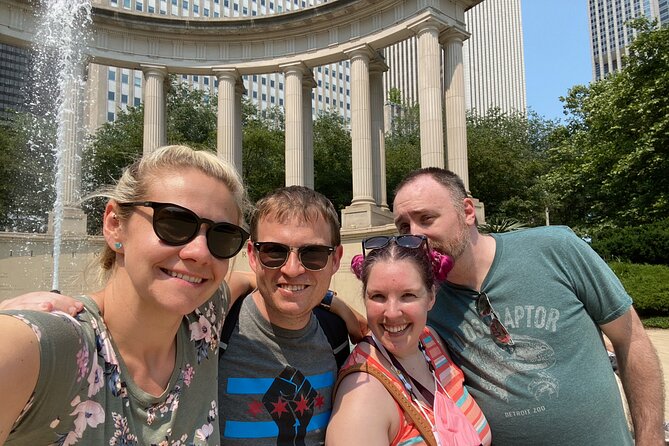
Wrigley Square contains the Millennium Monument, a nearly full-sized copy of the semicircle of paired Roman Doric columns that once occupied this part of Grant Park. The earlier peristyle stood near Michigan Avenue and Randolph Street from 1917 to 1953.
The square now includes a lawn and public fountain. Compared with Cloud Gate, it is a quieter and more formal setting, and the challenge encourages you to notice the relationship between the replica and the park around it.
This is the kind of stop that can be easy to overlook on a normal walk. The game gives it a place in the route and explains how Grant Park has changed over time. You are not simply checking off famous attractions. You are also seeing how Chicago preserves older ideas in newer public spaces.
Lurie Garden shows the city built over its own remains

Lurie Garden occupies an unusual site. The ground was filled, largely with rubble from the city destroyed in the Great Fire, and later formed over the roof of a parking garage. The garden was designed for this raised setting and for the layered story beneath it.
That detail gives the stop real weight. Chicago’s parks are not untouched pieces of nature. They are shaped by engineering, fire, rebuilding, parking, and public design. The garden asks you to think about what lies below the surface as much as what grows above it.
The challenge can make you pause over the garden’s layout and setting. If you are visiting with family, this is a useful point for a short break. The route allows you to stop and resume later, so you do not have to push through every location in one continuous burst.
Grant Park widens the route beyond Millennium Park
The route continues into Grant Park, where the scale changes. Millennium Park is compact and packed with major art installations. Grant Park spreads the experience across longer stretches and larger civic spaces.
Buckingham Fountain is one of the main highlights. Dedicated in 1927, it sits in the center of Grant Park between Queen’s Landing and Congress Parkway. It is recognized as a Chicago Landmark and is one of the largest fountains in the world.
The fountain makes a strong visual stop, but it is also where the app’s location system can matter. You need to be close enough for the game to recognize the area, and access may not always work as expected. A past playthrough became difficult when the group could not get within range and was not able to enter the fountain area. That is a useful warning: do not assume that every challenge can be solved from any nearby sidewalk.
If the app offers a hint or an expanded radius, using it may be the practical choice. The downside is that players who want to solve every clue without assistance may feel that the game loses some of its fun.
Lincoln and Solti add music and memory to the walk

Another stop features a sculpture of Abraham Lincoln seated in a chair, looking down into the distance. The description is spare, so the game’s challenge supplies the reason to inspect the monument and its surroundings.
The route also reaches the Sir Georg Solti Garden near Symphony Center, home of the Chicago Symphony Orchestra. The sculpture associated with this stop was moved to Grant Park and rededicated there in October 2006.
This section gives the activity a different mood. You move away from reflective steel and interactive fountains and toward monuments tied to national memory and classical music. It is one of the route’s strengths: the sights are not all variations on the same public-art theme.
Taft’s Fountain of the Great Lakes ends the experience
The stated finish is Taft’s Fountain of the Great Lakes near East Jackson Boulevard. Completed in 1913, it was the first commission funded by the Benjamin F. Ferguson Fund, created to support statues and monuments along Chicago’s boulevards and in public places.
The sculpture represents the Great Lakes as figures, giving the fountain a clear connection to Chicago’s location beside Lake Michigan and to the wider region. It is also a fitting endpoint because the work links civic art, public money, and the city’s physical setting.
The route ending here means you should allow enough energy for a full walk. The advertised duration is about 1 hour 35 minutes, but the real time can stretch if you stop for photographs, wait at crowded sites, or need to solve a clue more than once.
The endpoint is not the same as the starting point, so plan for the fact that you finish farther south than where you began. The route is near public transportation, which helps once the game is over.
What the $7.20 price really buys you
At $7.20 per person, this is a low-cost way to add a game to an outdoor Chicago walk. A group can also use available discounts, which may make the activity appealing for families or friends traveling together.
The price does not buy live guiding, museum admission, transportation, or a polished lecture. It buys access to a smartphone-based route with clues and information. That is good value if you already want to visit Millennium Park and Grant Park and enjoy a reason to look more closely at the surroundings.
I would not choose it if you want detailed architectural commentary, flexible route changes, or a person who can answer questions on the spot. The experience depends on your phone and your willingness to work through the challenges.
App limits, construction, and the need for comfortable shoes
The most important practical issue is the combination of walking and app location requirements. One playthrough ran into construction zones, blocked areas, and trouble reconnecting a player to the previous location. Another problem involved getting close enough to a fountain for the game to register the stop.
These problems may not occur on your visit, but they are possible. Construction changes, crowded areas, and restricted access can affect any location-based activity. Keep the hint function in mind, and do not let the desire to preserve every point ruin the outing.
Wear comfortable shoes. The route covers several parks and landmarks, and the full distance can feel significant even though the activity lasts under two hours. Bring a charged phone, and remember that the game is designed to work offline. That is helpful, but offline play does not remove all location or device issues.
The game is private, so only your group participates. Service animals are allowed, most people can take part, and the route is near public transportation. The activity is offered in English.
Who will enjoy this Chicago city game
This is a good match for:
- Families who want sightseeing to feel like a shared task
- Friends who enjoy puzzles and city walks
- Independent visitors who do not want a scheduled guide
- Repeat Chicago visitors looking for public art beyond the obvious photo stops
- Budget-conscious visitors who want a structured activity for less than the cost of many attractions
It is less suitable if you have limited mobility, dislike walking, or want a quiet, uninterrupted look at the parks. The route involves multiple outdoor stops, and the app may ask you to move close to particular landmarks.
It also requires patience. Some questions may feel light or silly, and directions between sites may not always be as clear as you want. If you prefer serious historical interpretation, treat the game as a supplement to your own sightseeing rather than a full Chicago history tour.
Booking, timing, and cancellation details
The experience is available every day from midnight to 11:59 p.m., so you can choose your own start time. Confirmation arrives when you book, and the activity is offered as a private experience for your group.
You can cancel for a full refund up to 24 hours before the scheduled start. Cancellations or changes made within 24 hours are not refunded or accepted. The advertised duration is approximate, so leave room for stops, photos, and any app trouble.
Should you book the Eastside Chicago Heist?
Book it if you want an inexpensive, flexible walk that mixes Cloud Gate and Crown Fountain with lesser-known pieces such as the Chicago Stock Exchange Arch, Calder’s Flying Dragon, and Taft’s Fountain of the Great Lakes. The offline option and pause-anytime format are especially useful for families and independent planners.
Skip it if you need a human guide, precise directions, or a flawless app experience. At $7.20, the risk is small, but the value depends on enjoying the game itself. Bring comfortable shoes, keep your expectations modest, and be ready to use a hint if construction or location range gets in the way.
FAQ
How long does the Eastside Chicago Heist take?
The activity lasts approximately 1 hour and 35 minutes. Your visit may take longer if you pause, take photographs, or spend extra time at the landmarks.
Where does the game start?
The starting point is 111 South Michigan Avenue, Chicago, Illinois 60603, outside the Art Institute of Chicago.
Where does the game end?
The stated endpoint is Taft’s Fountain of the Great Lakes near East Jackson Boulevard in Chicago.
Is a physical tour guide included?
No. This is a self-guided experience played through a smartphone app.
Can I pause the game?
Yes. You can start at any hour, take a break at any time, and resume later.
Does the game require an internet connection?
No. The game is designed to work offline, so an internet connection is not required to play.
Is this a private activity?
Yes. Only your own group participates in the activity.
What is the cancellation policy?
You can cancel at least 24 hours before the start time for a full refund. Cancellations or changes made less than 24 hours before the start time are not refunded or accepted.
More City Exploration Games in Chicago
- Malaga city game: Operation Mindfall
★ 5.0 · 111 reviews - Romantic Montmartre: Paris Lost Lovers Exploration Game and Tour
★ 4.5 · 107 reviews - Sibiu Old Town Exploration Game and Self-Guided Tour
★ 4.5 · 82 reviews - Glasgow Ghost Hunt: The Soul That Got Away Exploration Game
★ 4.0 · 71 reviews
New puzzles around Chicago
- Adventurous Scavenger Hunt in Chicago by Zombie Scavengers★ 5.0 · 2 reviews
- Lincoln Park Zoo Adventure★ 3.5 · 2 reviews
- Chicago Scavenger Hunt Adventure★ 5.0 · 5 reviews
- Chicago Scavenger Hunt and Highlights Self Guided Audio Tour★ 5.0 · 2 reviews
- Haunted Chicago Exploration Game and Tour★ 4.0 · 6 reviews
- Secrets of Lincoln Square: Self-Guided Puzzle Quest in Chicago★ 4.5 · 2 reviews
- Chicago Scavenger Hunt Adventure★ 3.0 · 2 reviews
- Chicago Chocolate Tour★ 3.5 · 5 reviews
Heist and Spy Games, head to head.






Chattanooga “Secret Agent” Escape Room Admission Ticket
Read our review →
Other lists this game appears in