
Review · BARCELONA
Barcelona: “The Secret of Cerdà” Treasure Hunt Walking Tour
Barcelona’s best feature for this game is its mix of grand streets and small clues. The Secret of Cerdà turns the city center into an outdoor escape room, sending you between five major sights while an eccentric architect’s plans guide the mystery. You carry the map, challenge book, locks, and tools, so this is more active than a standard walking tour.
I like the private format, since your group can solve the puzzles at its own speed without strangers taking over. I also like the way the route gives you time to notice Barcelona’s architecture, especially around the Illa de la Discòrdia and the Eixample. The main catch is time: the game is billed at two hours, but one family needed longer even without stopping along the way.
Key points to know before you book
- A private outdoor escape room: You play only with your own group, which keeps the puzzles relaxed and personal.
- Five central Barcelona stops: The route connects the Illa de la Discòrdia, Gothic Quarter, Eixample, Plaça de Catalunya, and Palau de la Música.
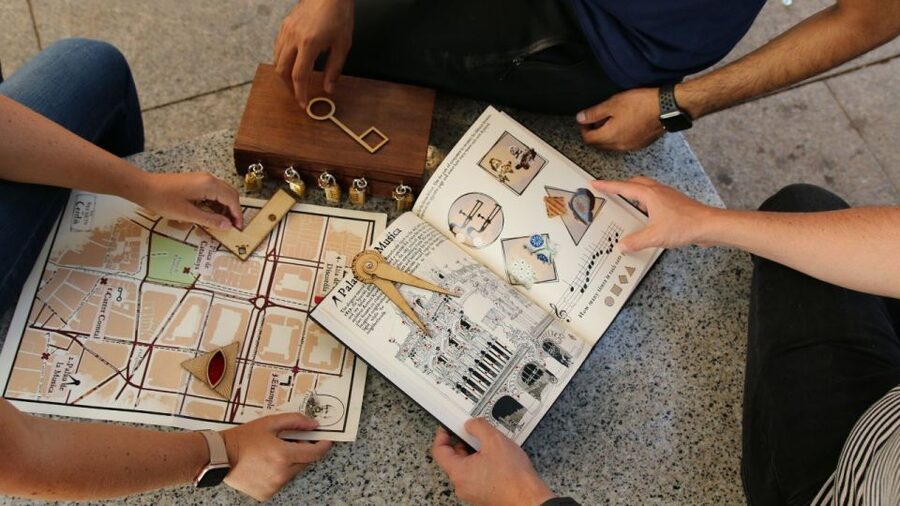
- A backpack of physical tools: You receive a treasure map, challenge book, treasure box, and other game materials at the starting shop.
- Puzzles with optional QR help: Codes and locks can be tricky, but QR support is available when you need a nudge.
- Best for families with older children: The game is designed for adults, but children age 7 and up can play with parents.
- Allow more than two hours: The official duration is 2.5 hours, and you may want extra time for photos, food, shopping, or a slower solve.
Why this Barcelona treasure hunt works
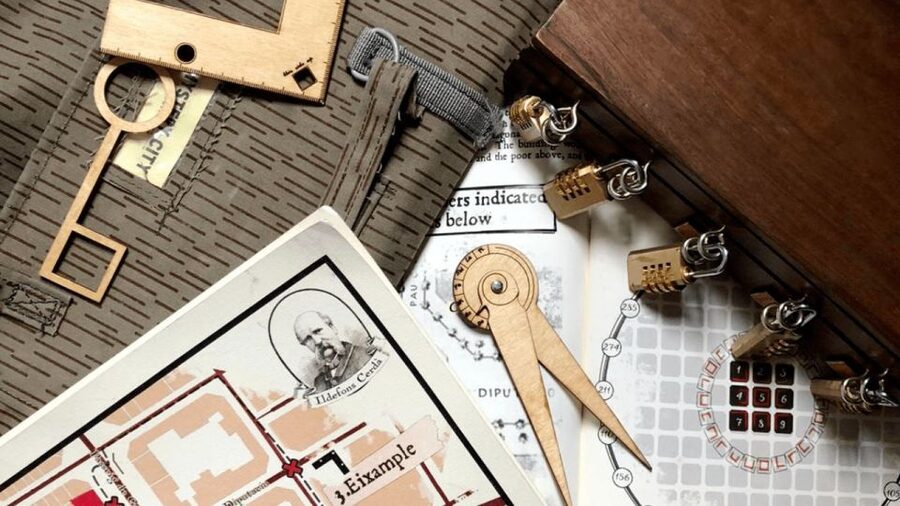
This is not a guided lecture with a fixed script. It is a self-guided puzzle walk built around Barcelona’s central sights. At the start, you pick up a backpack near Plaça Urquinaona, on Carrer de Trafalgar 17, then use the map and an old book to work through a mystery linked to an architect from Barcelona’s past.
The story gives your walk a purpose. Instead of simply moving from one famous place to another, you look for details, read clues, handle locks, and connect each stop to the next challenge. I like this approach for people who lose interest during long explanations but enjoy solving a problem with their hands and eyes.
You should know that the activity is not a race. The route takes about two hours as a game, while the booking information gives the full experience 2.5 hours. You are encouraged to stop for photos, food, shopping, and sightseeing. That flexibility is useful in Barcelona, where a short route can easily stretch when you pause to look at a façade or stop for a snack.
The game has a current rating of 4.4 from 19 ratings. The strongest praise centers on the fun, interactive format, the outdoor escape-room idea, and puzzles that feel challenging without being impossible. One participant also found the distance manageable but still substantial, so wear shoes that can handle a couple of hours on city streets.
More Treasure Hunts in Spain
Starting near Plaça Urquinaona
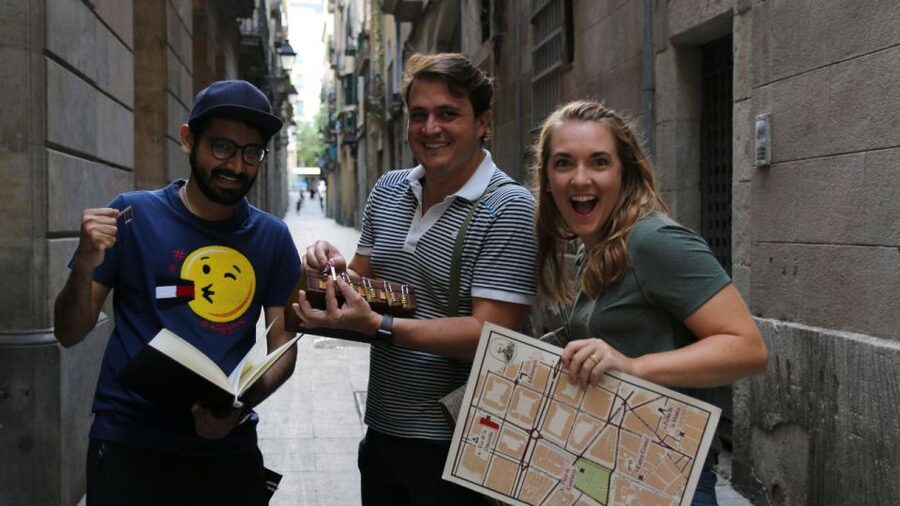
Your starting point is Carrer de Trafalgar 17, close to Plaça Urquinaona. This is a practical place to begin because the route quickly places you in central Barcelona, with several major districts and sights within walking distance.
At the shop, you collect the backpack containing the equipment for the game. Expect the core kit to include a treasure map, treasure box, book of challenges, and magical tools. The physical gear matters here. You are not just reading clues on a phone, and the locks give the group something concrete to work on together.
The activity provider, Mystery City, makes the game available in English, Spanish, Catalan, and French. That choice is important for a puzzle walk, since a missed word can affect the whole answer. Pick the language that lets everyone in your group follow the clues comfortably.
You should not plan to play alone. The game was designed for a group, and several tasks are more enjoyable when one person reads, another searches, and someone else tries the lock. All bookings are private, so you do not have to merge with another party.
Illa de la Discòrdia: Barcelona’s architectural face-off
The first listed sightseeing stop is the Illa de la Discòrdia, the famous stretch of Passeig de Gràcia known for its striking modernist façades. Even without the puzzle, this is one of the best places in central Barcelona to compare different architectural ideas in a very small area.
Here, the game asks you to pay close attention. Look for the details that are easy to miss when you only take a quick photograph. The challenge is tied to the stop, and solving it gives you the information needed for one of the locks on the treasure box.
The planned sightseeing time is about 20 minutes. That is enough for a focused look, but not a full architectural study. If you want time to examine every façade, photograph the buildings, and read more about the area, you may need to add time beyond the game’s basic schedule.
This is one of the strongest parts of the route for architecture fans. It also helps set the tone: the city itself is part of the puzzle, not just a backdrop.
The Gothic Quarter: clues among older streets
The route then moves into the Gothic Quarter, where the mood changes from broad modern avenues to older, tighter streets. This section gives the hunt a different texture and makes the city feel less like a series of postcard stops.
The challenge here encourages you to notice small details and find a location or clue that you might otherwise pass. Since the activity does not provide a traditional guide walking beside you, the book and map need to do the teaching. Read the story carefully, then use the surroundings to test your answer.
I like the contrast between this stop and the Illa de la Discòrdia. One focuses on bold façades and planned urban drama. The other gives you a more enclosed route through the old center. That variety keeps the walk from feeling repetitive.
The suggested time is about 20 minutes. The Gothic Quarter can also be the point where your group slows down, especially if you stop for food or begin following side streets. Keep track of the puzzle materials and the route, since the game works best when sightseeing and solving remain connected.
More Treasure Hunts in Barcelona:
- Hamburg: Treasure Hunt Game through HafenCity
★ 4.7 · 364 reviews - St. Augustine: Treasure Hunt Cruise with Onboard Show
★ 4.4 · 315 reviews - Málaga: Private Sightseeing Treasure Hunt
★ 4.8 · 297 reviews - Fun, Flexible Treasure Hunt Around Manchester with Cryptic Clues & Hidden Gems
★ 5.0 · 253 reviews
Eixample and the city Cerdà planned
The Eixample is central to the story of this activity. The mystery is built around an eccentric architect from Barcelona’s past who hid clues in his plans for the city. The name Cerdà points to Ildefons Cerdà, whose urban plan shaped the broad grid and distinctive blocks of the Eixample.
The activity does not ask you to sit through a planning lecture. Instead, it uses the streets as a visual puzzle. As you walk, you get a practical sense of how the city’s layout differs from the older quarter. Wide roads, repeated blocks, and planned intersections make more sense when you are actively looking for patterns.
This is also where the experience can feel most educational without becoming formal. You are learning through movement. The challenge gives you a reason to study the city plan and connect it to the story in the book.
The stop is listed at roughly 20 minutes, but the Eixample is a useful place to add a pause. If your group enjoys architecture, you may want to spend longer looking at the blocks and façades. If your children are eager to reach the next lock, keep the pace moving and save extra sightseeing for the end.
Plaça de Catalunya: a useful pause point
Plaça de Catalunya is one of Barcelona’s main central squares and a natural point in the route. It connects the old center with the Eixample, so it fits the larger idea behind the game: you are crossing between different parts of the city while following one continuing mystery.
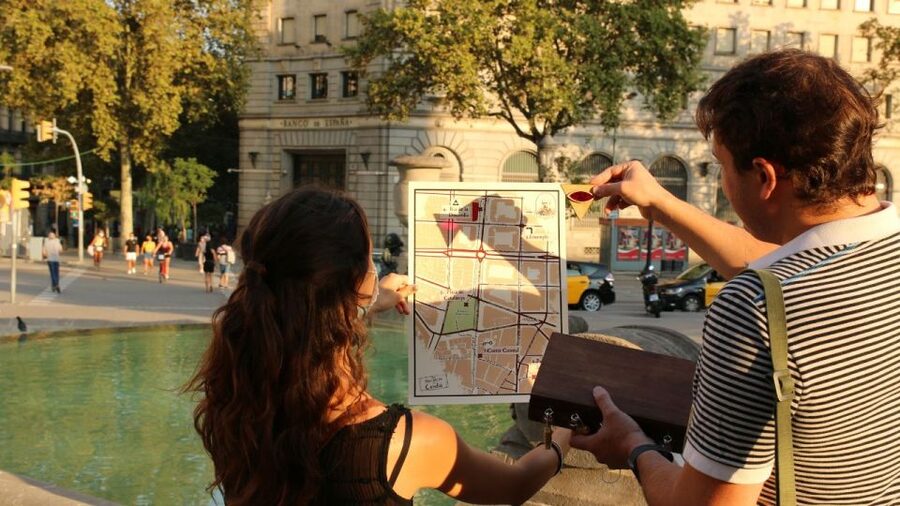
The square is open and easy to recognize, which can make it a welcome reset after the narrower streets of the Gothic Quarter. Use this stop to check your map, organize the backpack, and make sure everyone understands the next challenge.
The planned sightseeing time is about 20 minutes. You may find this stop less intimate than the Gothic Quarter or less detailed than the modernist buildings, but it helps you understand Barcelona’s central layout. It is also a practical place for a short break if your group needs one.
Because the activity is self-guided, your group controls the rhythm. You can spend the full time on the puzzle, or pause for photos and take in the square before moving on.
Palau de la Música Catalana: a grand final stop
The Palau de la Música Catalana is the most theatrical stop on the route. Its ornate Catalan modernist design gives the final part of the hunt a strong visual setting, and the building is one of the city center’s most memorable landmarks.
The challenge at this point is another step toward opening the treasure box. You are not simply collecting facts. You are combining information from earlier stops, the map, and the challenge book to work out the codes.
The route lists about 20 minutes here. That is enough for an exterior look and the activity itself, but it is not a substitute for a full interior visit or concert experience. If the palace is high on your Barcelona list, treat the treasure hunt as a way to see it from the outside and plan a separate visit if needed.
I like having this building near the end because it gives the walk a clear visual finish. Once the locks are solved, you return to the starting point to claim the prize and complete the mystery.
How hard are the puzzles?
The game is aimed at adults, but children age 7 and up can take part with their parents. That makes it a better match for families with school-age children or teenagers than for very young children who may not follow the story or wait patiently while adults solve codes.
The puzzles are meant to be challenging enough to hold your attention. One participant described the format as an outdoor escape room and found the challenges and walking distance well judged. QR codes are available for the trickier parts, which gives you help without removing the satisfaction of solving the puzzle yourself.
Do not expect every answer to come instantly. A good group divides the work: one person reads the instructions, one studies the map, and another tests the lock or searches for the relevant detail. That simple teamwork can make the activity much more fun.
The physical locks also make the experience a good choice for people who prefer hands-on games. If your group dislikes puzzles, gets frustrated easily, or wants a fully guided tour, this may feel like work rather than play.
Time, walking, and the real value of $26
At $26 per person, the experience costs more than a basic self-guided city walk, but you are paying for the private game kit, the story, the challenge design, and the chance to see several central sights in one outing. For a family or small group that would otherwise pay for an escape room and a city tour separately, the price can make sense.
The value depends on how much you enjoy the format. If you like solving problems, the backpack and physical treasure box add real value. If you only want facts about Barcelona, a conventional walking tour may give you more explanation for the same time.
The advertised duration is 2.5 hours, with the game itself taking about two hours. One participant needed a little longer even without stopping, so I would avoid booking a tight meal reservation immediately afterward. Add time for photographs, shopping, and food if those are part of your plan.
The route is wheelchair accessible, according to the activity information. The walk still passes through several central areas and includes multiple stops, so consider your group’s energy and pace when planning the day.
Cancellation is free up to 24 hours before the activity, and you can reserve while paying later. Those terms are useful if your Barcelona schedule is still changing.
Who should choose The Secret of Cerdà?
I would choose this for adults who like escape rooms, families with children 7 and up, and friends who want sightseeing with a clear task. It also suits repeat Barcelona visitors who have seen the main center before and want a fresh reason to examine familiar streets.
The private setup is especially helpful for families. You can give children small jobs, take breaks, and use the QR help without worrying about holding up another group.
I would hesitate if your main goal is detailed architectural instruction, a relaxed café-to-café walk, or a guide who handles all navigation. The clues require attention, and the walk works best when everyone is willing to participate.
Should you book this Barcelona puzzle walk?
Book it if you want your city sightseeing to feel like a game. The strongest reasons are the private format, the physical puzzle kit, the mix of old and modern Barcelona, and the outdoor escape-room structure. You get five central stops without spending the whole outing listening to a lecture.
Skip it if your schedule is very tight or your group has little patience for codes and locks. Give yourself more than the basic two hours, wear comfortable shoes, and keep the afternoon flexible.
For families and puzzle fans, $26 is a fair price for a private activity that combines play, walking, and Barcelona’s architecture. Just remember that the treasure hunt is the tour. The city sights support the mystery, and your group needs to do the solving.
FAQ
Where does the Barcelona treasure hunt start?
It starts at Carrer de Trafalgar 17, near Plaça Urquinaona.
How long does the activity take?
The full activity is listed as 2.5 hours. The game itself takes about two hours, but you are encouraged to take extra time for photos, shopping, food, and sightseeing.
Which places does the route visit?
The route includes the Illa de la Discòrdia, Gothic Quarter, Eixample District, Plaça de Catalunya, and the Palau de la Música Catalana.
Is this a guided walking tour?
No. It is a self-guided treasure hunt. You collect the backpack and follow the map, book, and challenges with your own group.
What equipment is included?
The backpack includes a treasure map, treasure box, book of challenges, and magical tools.
What languages are available?
The activity is available in English, Spanish, Catalan, and French.
Can children take part?
The game is designed for adults, but children age 7 and up can play with their parents. Children under 6 are not suitable for the activity.
Is the activity private and wheelchair accessible?
Yes. Each booking is private for your own group, and the activity information states that it is wheelchair accessible.
New puzzles around Barcelona
- The Goldheist – Private City Escape Game in Barcelona★ 5.0 · 3 reviews
- Private Treasure Hunt The Explorer | Guided, fun & 100% Offline | Xventura★ 5.0 · 6 reviews
- Xcape Room Bcn: Corpse Gallery Escape Room Barcelona★ 5.0 · 3 reviews
- Barcelona escape game, time travel★ 4.0 · 7 reviews
- Private Family Treasure Hunt | Guided, fun & 100% Offline | Xventura Barcelona★ 5.0 · 6 reviews
- Barcelona private Family-Friendly Cultural & Food Tour★ 5.0 · 3 reviews
- Barcelona: The Search for the Snake Stone City Treasure Hunt★ 4.6 · 12 reviews
- Barcelona: Escape Room Experience and Sailing Cruise★ 4.5 · 2 reviews
Treasure Hunts, head to head.
Fun, Flexible Treasure Hunt Around Manchester with Cryptic Clues & Hidden Gems
Read our review →York Treasure Hunt Adventure: The Mystery of The Gunpowder Snitch
Read our review →
Black Diamond Treasure Hunt Excursion with Backcountry Dining
Read our review →
Amsterdam Treasure Hunt: The Mystery of a Secret Sender
Read our review →
Private city discovery tour – A Historical Treasure Hunt
Read our review →
Mostra Leonardo Da Vinci: Rome Treasure Hunt Game
Read our review →Other lists this game appears in