
Review · BERLIN
Love and War in Berlin: Self-Guided Story Puzzle Walk
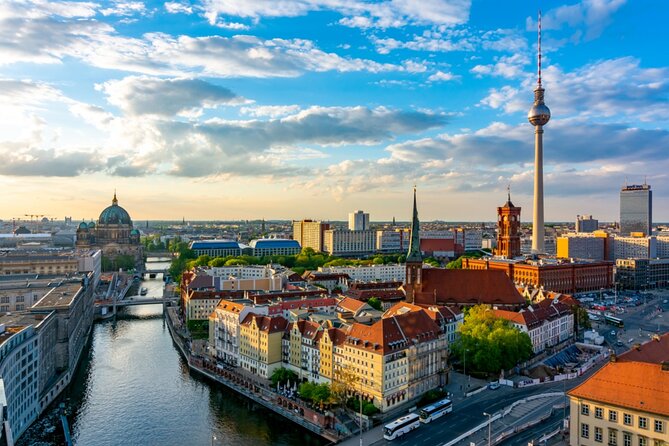
Berlin’s past comes at you quickly on this self-guided puzzle walk, which links Alexanderplatz with the Memorial to the Murdered Jews of Europe. You solve clues at monuments and public squares while moving through the city center, with the story touching on Nazi Germany, the Second World War, Prussia, the GDR, and modern Germany.
I like the freedom to start at any hour and stop whenever you need a coffee or a museum break. I also like the price: at $6 per person, this gives you a useful hour of sightseeing and historical context for less than the cost of many Berlin snacks. The main drawback is that there is no human guide, and a few clues may demand very exact answers.
Key points at a glance
- Start at the World Clock: Begin beside Alexanderplatz’s Urania World Clock, a practical meeting point with a clue built into the monument.
- Walk through many eras: The route connects imperial Berlin, Nazi history, the GDR, and today’s federal capital.
- Visit Hitler’s former bunker site: The walk ends near the location of the former Führerbunker, now close to the Holocaust Memorial.
- Play offline: You do not need a live internet connection once the city game is ready.
- Set your own rhythm: Start any time during the operating window, pause, and continue later.
- Expect mostly easy puzzles: Some are quick to solve, while others rely on precise wording or careful observation.
Berlin history told through a city game
This is not a standard walking tour with a guide waiting at the first stop. It is a private activity for your own group, delivered through a mobile device in English. At each location, you look around for a detail, answer a challenge, and receive the next place and part of the story.
That format suits Berlin particularly well. The city center is filled with buildings and memorials that can seem disconnected at first. A puzzle gives you a reason to examine a statue, read a plaque, or notice an architectural detail instead of simply walking past it.
The title points toward love and war, but the route is broader than a single romance or battlefield tale. It moves through monuments tied to kings, socialism, Nazi repression, wartime Berlin, and the country’s uneasy effort to remember its past.
The supplied duration is about one hour. That is a sensible estimate for the puzzle itself, though your total time can stretch if you stop at the landmarks, take photos, or pause for food. The route is described as manageable and not too far, but it crosses several central neighborhoods and includes a fair amount of walking between stops.
More Self-Guided Games in Germany
- Berlin: Self-Guided Family and School Class Scavenger Hunt
★ 4.6 · 128 reviews - Berlin: Scavenger Hunt Self-Guided Tour
★ 4.6 · 79 reviews - Berlin Wall: Greatest Escapes Self-Guided Walking Adventure
★ 4.5 · 27 reviews
Start beside the World Clock at Alexanderplatz
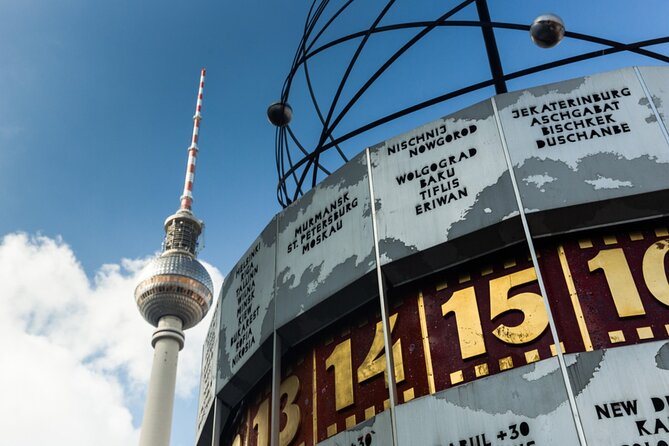
Your starting point is Alexanderplatz, at Alexanderplatz 1. The large World Clock, also called the Urania World Clock, is easy to identify. Its metal rotunda shows the current time in 148 major cities, giving you an immediate visual clue that this is more than an ordinary clock.
The opening challenge asks you to inspect the clock and find the information needed to continue. That is a good choice for the first puzzle because it gets you looking closely from the beginning. You are not just pressing start and following a blue line on a map. You need to use the place around you.
Alexanderplatz is also a useful place to begin because it has strong public transport connections. The square can be crowded, so take a moment to get oriented before starting the game. If you rush into the first challenge, the number of signs, buildings, and people around the clock may make the answer harder to spot.
The Rathaus and Neptune Fountain
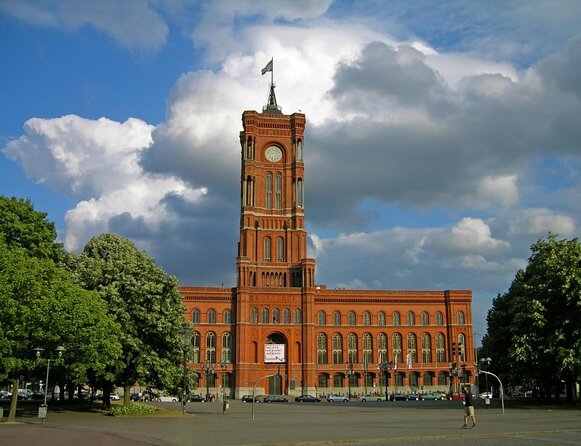
The next part brings you to the Rathaus, Berlin’s red-brick city hall. Built between 1861 and 1869, it was designed by Hermann Friedrich Waesemann in the Northern Italian High Renaissance style. Its tower was influenced by Notre-Dame de Laon in France, while the building itself was modeled on the old town hall of Toruń, Poland.
This stop widens the story beyond the Second World War. Berlin’s identity did not begin in 1933, and this building helps place later events in a longer civic and architectural setting. The challenge again asks you to look around for a specific answer, so the building’s details matter.
The route then reaches the Neptune Fountain, or Neptunbrunnen. Made in 1891 by Reinhold Begas, it places the Roman god Neptune at the center of a dramatic sculptural group. The fountain is one of the more visual stops, and the stated time here is about 10 minutes.
You do not pay an admission fee at either location. That matters because the $6 price covers access to an outdoor route rather than entry to indoor attractions. You can see the sites without adding museum tickets to the day’s budget.
Marx and Engels in the former GDR center
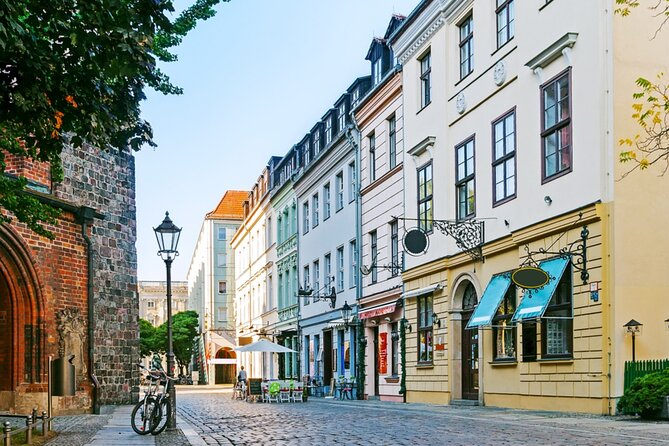
At Marx-Engels-Forum, the story shifts toward the German Democratic Republic. The park was created by East German authorities in 1986 and named for Karl Marx and Friedrich Engels, authors of The Communist Manifesto.
This is one of the most useful stops for understanding that Berlin’s political story did not end with the fall of Nazi Germany. The city was later divided, and East Berlin used monuments and public spaces to promote a socialist identity. The puzzle asks you to study the setting before moving on, which makes the park more than a passing waypoint.
You might find this section less emotionally intense than the later memorials, but it supplies needed contrast. A walk that covered only Nazi sites would leave out a major part of Berlin’s twentieth-century experience. Here, you see how public space was shaped by another political system.
More Puzzle Walks and Quests in Berlin:
- Spy Mission in Berlin: Self-Guided Espionage Puzzle Quest
★ 5.0 · 3 reviews - Fun, Flexible Treasure Hunt Around Manchester with Cryptic Clues & Hidden Gems
★ 5.0 · 253 reviews - Fun, Flexible Treasure Hunt Around York with Cryptic Clues & Hidden Gems
★ 5.0 · 248 reviews - Fun, Flexible Treasure Hunt Around Bath with Cryptic Clues & Hidden Gems
★ 5.0 · 208 reviews
Lustgarten and Neue Wache
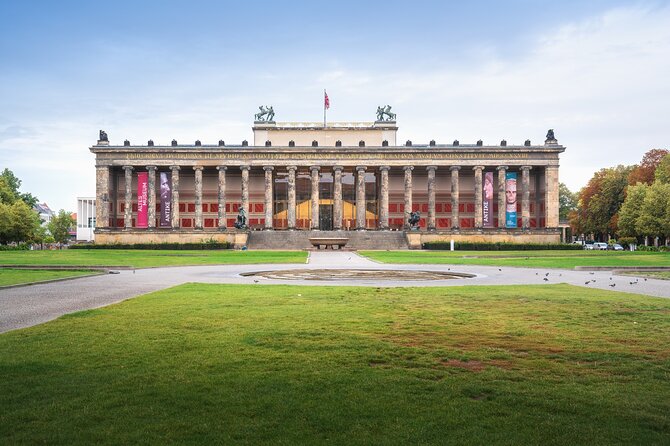
The route continues to Lustgarten on Museum Island. The name means Pleasure Garden, although the space has served several different purposes over time. It began as part of the Berlin City Palace grounds and was later used as a parade ground, a place for mass rallies, and a public park.
That changing use gives the location real weight. The same open space can serve royal power, military display, political mass gatherings, and ordinary public life. The game’s question encourages you to read the place in that wider context.
Nearby, Neue Wache provides a sharper memorial focus. Karl Friedrich Schinkel designed the building between 1816 and 1818 as a guardhouse for the royal palace and a memorial to the Liberation Wars. Its severe neoclassical design makes it one of the most memorable buildings along Unter den Linden.
This section is best taken slowly. Even if the puzzle answer is obvious, pause to look at the building’s shape and position on the boulevard. The experience works best when you treat the challenges as prompts to observe Berlin, not merely as hurdles to clear.
Bebelplatz and the 1933 book burning
Bebelplatz is one of the route’s most important stops. On May 10, 1933, Nazi-organized student groups burned books here and in other German university cities. The event targeted works seen as politically or culturally unacceptable by the new regime.
The square’s appearance can feel deceptively calm. That contrast is part of what makes the stop effective. You are standing in an open public space surrounded by major buildings, yet the place carries a direct reminder of censorship, intimidation, and the destruction of independent thought.
The activity allows about 10 minutes here. Use that time to solve the clue, then give yourself a moment to consider what the event meant. This is not simply a stop for a quick photograph. It shows how authoritarian rule can begin by controlling words, education, and public culture.
The stop also helps explain why a route marketed around war history includes places where no battle occurred. Berlin’s story is not only about military events. It is also about propaganda, public pressure, and the erosion of civil rights.
Gendarmenmarkt and the political capital
Gendarmenmarkt is another major square, framed by two churches and the Konzerthaus Berlin. Its name comes from the Gens d’Armes cuirassier regiment, whose stables once occupied the site before being demolished under Frederick II.
The square provides a change of mood from Bebelplatz. Its architecture is formal and grand, and its layout rewards a wide look before you focus on the clue. The stated stop time is about 10 minutes, although construction or public events can affect how easily you move through the space.
One practical point comes from the nature of this activity: the route depends on what is physically visible around you. A Christmas market or temporary event can block a sign, statue, or path. If that happens, do not assume the game has failed. You may need to walk around the temporary obstruction or approach the location from another side.
The route then passes the State Representation of Hamburg, a classicist town house on Jägerstraße. The building hosts political meetings and public events, and Hamburg uses it to take part in federal politics and legislation through the Bundesrat.
This is a fine example of how the walk reaches into present-day Germany. You are not only looking at monuments to rulers or victims. You are also seeing the working machinery of the federal republic.
The Holocaust Memorial and the former bunker site
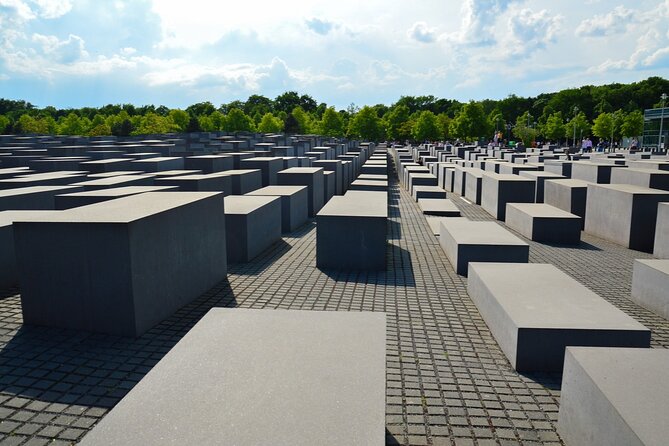
The final section brings you to the Memorial to the Murdered Jews of Europe on Cora-Berliner-Straße. The German parliament approved the central memorial after lengthy debate, and the site opened in 2005. New York architect Peter Eisenman won the design competition.
The memorial’s field of concrete stelae changes as you walk through it. The route’s reference to Hitler’s former war bunker adds another layer, since the bunker site lies in this part of central Berlin. The bunker itself is not presented as a visitor attraction, and you should not expect an underground tour. The value here is the connection between the end of the Nazi regime and the way present-day Berlin marks the crimes committed under it.
This ending is strong because it leaves you with a question rather than a tidy finish. The city has built a major memorial near the place where Hitler spent his final days, but the memorial is dedicated to the Jewish victims of Nazi persecution. The two locations are close, yet they carry very different meanings.
Allow extra time if you want to walk through the memorial carefully. The game may take about an hour, but rushing away immediately after the final clue would reduce the impact of the last stop.
How the puzzles work in practice
The challenges are based on observation. At each location, you search for an answer in the surroundings, enter it into the game, and receive the next step. The questions vary in difficulty. Some are very easy, while others depend on precise wording or a detail that is easy to overlook.
That mix can be enjoyable for a small group. One person may notice a number, another may read the architecture, and a third may interpret the question. It gives children and adults a shared task, though younger children may need help with the historical background.
The game works offline, which is useful if your mobile connection is weak or you want to conserve data. You still need a phone or other mobile device to play, but you are not dependent on constant internet access during the walk.
The lack of a guide is both the point and the limitation. You can move at your own pace, avoid joining strangers, and take a break whenever you want. But no one is present to explain a confusing clue, answer follow-up questions, or add personal stories about the sites.
Price, timing, and who gets the most value
At $6 per person, this is inexpensive for Berlin. The price is especially fair if you want a structured introduction to central Berlin but do not need a full guided tour. It costs less than most formal sightseeing activities and includes a route through several major public landmarks.
The value falls slightly if you expect a detailed lecture on Second World War history. The game provides an overview and short pieces of context, not the depth of a museum visit or a specialist-led walk. I would pair it with the Documentation Center at the Topography of Terror, the German Historical Museum, or another serious history stop if you want more background.
The activity is available every day from 5:00 AM to 9:00 PM during the stated operating period. It is also open around the clock for booking, though the practical activity hours given are 5:00 AM to 9:00 PM. Starting early may give you quieter public squares, while a later start can work well after a museum visit.
Group discounts are available. Since the activity is private, only your own group takes part. Service animals are allowed, and most people can participate. The route is near public transportation, but the information provided does not specify a step-free route or detailed accessibility conditions, so check before booking if that matters to you.
Free cancellation is available up to 24 hours before the start time. Within 24 hours, the payment is not refunded and changes are not accepted.
Who should book this Berlin puzzle walk?
I would choose this for couples, families with older children, friends, or independent visitors who like solving clues more than following a flag. It is also a good choice if you have only a short amount of time and want to connect several central landmarks without committing to a half-day tour.
It suits repeat visitors too. Even someone who has lived in Berlin for years might find a new detail or unfamiliar corner along the route. The activity is not limited to first-time sightseeing.
I would not choose it as your only history experience in Berlin. The short format cannot explain every site in depth, and tricky wording may frustrate you if you want a smooth, story-led walk. If you prefer asking questions as you go, book a live guide instead.
Should you book it?
Book this $6 walk if you want a low-cost, flexible way to see central Berlin while solving simple location-based puzzles. The route covers an unusually broad range of subjects, from the World Clock and Prussian architecture to the GDR, Nazi book burning, the federal government, and the Holocaust Memorial.
Skip it if you need a live expert, a fully explained WWII tour, or guaranteed access to every clue during crowded events. For everyone else, it is a practical add-on to a Berlin day, especially when you want to set your own pace and let the city’s monuments provide the classroom.
FAQ
Where does the activity start?
It starts at Alexanderplatz 1, 10178 Berlin, Germany, beside the World Clock.
Where does the activity end?
It ends at Cora-Berliner-Straße 1, 10117 Berlin, near the Memorial to the Murdered Jews of Europe.
How long does the walk take?
The expected duration is about one hour, though stops, photos, breaks, and puzzle-solving speed can make it longer.
Is the activity guided by a person?
No. It is a self-guided mobile experience, and no physical tour guide is included.
What language is available?
The activity is offered in English.
Can I start at any time?
You can start at any hour during the stated operating hours of 5:00 AM to 9:00 PM, Monday through Sunday.
Do I need an internet connection?
No. The game can be played offline, so a live internet connection is not required during the activity.
Is this a private activity?
Yes. Only your own group participates.
Are group discounts available?
Yes. Group discounts are listed as a feature of the activity.
Can I cancel for a full refund?
Yes, if you cancel at least 24 hours before the experience start time. Cancellations within 24 hours are not refunded.
More Self-Guided Games in Berlin
- Berlin Kreuzberg: Scavenger Hunt Self-Guided Tour
★ 4.1 · 19 reviews - Berlin Prenzlauer Berg: Scavenger Hunt Self-Guided Tour
★ 4.6 · 14 reviews - Berlin Scavenger Hunt and Highlights Self-Guided Tour
★ 4.0 · 7 reviews - Berlin Highlights Self guided scavenger hunt and Walking Tour
★ 4.5 · 4 reviews
New puzzles around Berlin
- Private Tutankhamun’s Tomb Live Escape Room in Berlin★ 3.5 · 11 reviews
- Winter is Coming Live Escape Room in Berlin★ 3.0 · 5 reviews
- Kreuzberg’s Secret Society: Exploration Game and Tour★ 4.5 · 3 reviews
- Berlin Highlights Self guided scavenger hunt and Walking Tour★ 4.5 · 4 reviews
- First Profiler Berlin: Private Self-guided Outdoor Escape Game★ 3.5 · 3 reviews
- Berlin stories – an exciting scavenger hunt tour★ 3.5 · 2 reviews
- Scavenger Hunt from Maranja Adventure Club★ 5.0 · 6 reviews
- Berlin Wall: Greatest Escapes Self-Guided Walking Adventure★ 4.5 · 27 reviews
Puzzle Walks and Quests, head to head.
Fun, Flexible Treasure Hunt Around Manchester with Cryptic Clues & Hidden Gems
Read our review →
Escape Old Edinburgh with a Thrilling Outdoor Puzzle Trail
Read our review →
Scholars & Secrets of Cambridge: Self-Guided Puzzle Adventure
Read our review →
Brussels Old Town & Beer Secrets: Self-Guided Puzzle Walk
Read our review →
Other lists this game appears in