
Review · ITALY
Bologna Secrets Quest: Self-Guided Hidden Gems Adventure
Bologna Secrets Quest turns the old center into a city-sized puzzle, starting beneath the Two Towers and winding through medieval gates, market lanes, grand piazzas, and the university district. You look closely at buildings and public details, solve 14 challenges, and learn why each place matters. I like the freedom to start and stop when you wish, and the low price makes this an easy add-on to a Bologna visit. The main concern is the app: map errors, construction changes, or trouble downloading Questo can slow you down.
I especially like two things here. First, you see famous sights such as Piazza Santo Stefano and Neptune’s Fountain while also reaching lesser-known corners. Second, the private format keeps the game within your own group, so children and friends can work at their own pace. Bring a charged phone, allow more than 90 minutes if you stop often, and treat the clues as a flexible guide rather than a perfectly maintained route.
Key points to know before you play
- Fourteen puzzles connect Bologna’s towers, gates, squares, and market lanes.
- The route begins at the Two Towers and ends near Via Giuseppe Petroni.
- You can pause for coffee, lunch, photos, or a museum visit and resume later.
- The game is designed for your own group, with no physical guide leading the way.
- It costs $6.60 per person, making it one of the cheaper structured ways to see the center.
- Allow extra time and stay flexible if construction or map links affect a clue.
A self-guided way into Bologna’s old center
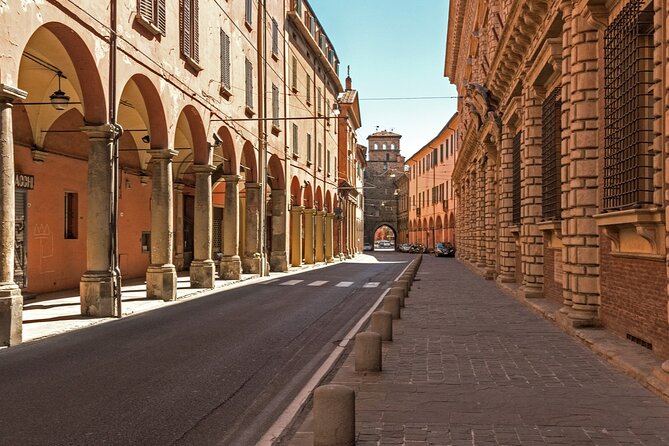
Bologna rewards slow looking. Its streets are full of porticos, brick towers, old shopfronts, carved details, and small signs that are easy to miss when you simply follow a sightseeing map. This quest gives you a reason to stop and inspect them.
The format is simple. You receive a mobile access code, use the Questo app, and follow a story built around Bologna’s mysteries. At each point, you search for an answer before moving on. The questions are not just trivia pulled from a screen. They direct your attention to the details around you.
That makes this a good fit if you want structure without a guide. You do not need to keep up with a group or arrive at a fixed departure time. The activity is available all day, and you can pause whenever the city offers something more tempting, such as a church interior, a food stop, or a market stall.
The route takes about 90 minutes on paper. In practice, I would allow two hours or more if you want to solve the puzzles carefully, take photographs, or stop along the way. One participant found the walk longer than the advertised 3 kilometers, so comfortable shoes and a little spare time are sensible.
More Self-Guided Games in Italy
- Florence Self-Guided Treasure Hunt & Medici Mystery Walking Tour
★ 5.0 · 69 reviews - Siena Medieval Power Quest: Self-Guided Family Feud Game
★ 4.5 · 38 reviews - Venice Scavenger Hunt and Highlights Self Guided Audio Tour
★ 4.5 · 20 reviews
Starting beneath Bologna’s Two Towers
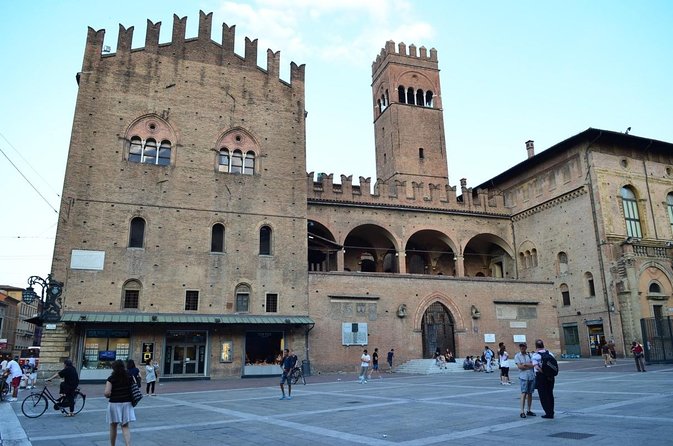
The quest begins at Piazza di Porta Ravegnana, the square dominated by Bologna’s Two Towers. This is one of the most recognizable places in the city, but it is also a useful starting point because you are immediately surrounded by clues about medieval Bologna.
The square lies a short walk east of Piazza Maggiore and the cathedral. Look up before opening the app. The towers, brickwork, surrounding buildings, and changing angles from the square give you a quick sense of how crowded and vertical the medieval center once was.
Your first challenge asks you to examine the area and find an answer that sends you onward. That basic pattern continues throughout the game. You are not entering a museum or receiving a lecture. You are using the public space itself as the material for the puzzle.
The opening stop is free to visit, of course, and you can take your time getting oriented. This is also a good place to check that the app, access code, and phone location are working before you walk farther from the center.
Piazza Santo Stefano and Palazzo Isolani
From the towers, the route takes you toward Piazza Santo Stefano. This is one of Bologna’s most attractive public spaces, with long porticos on two sides and the Basilica of Santo Stefano filling the short southeastern end.
The square is used for concerts, cultural events, and flea markets, so its appearance can change from one visit to another. That gives the puzzle a pleasant sense of place, but it also means you should expect people, displays, or temporary structures to affect what you can see.
The nearby Palazzo Isolani adds another layer. The palace faces the square on Via Santo Stefano and combines Gothic and Renaissance features. The Isolani family was an important medieval presence in Bologna, and the buildings beside the basilica reflect that connection.
I like this stop because it asks you to compare the formal square with the details around it. You get a major architectural sight without being pushed through it in a hurry. If you want to enter the basilica or pause under the porticos, this is an obvious place to stop the game and resume later.
Piazza Galvani and the Archiginnasio
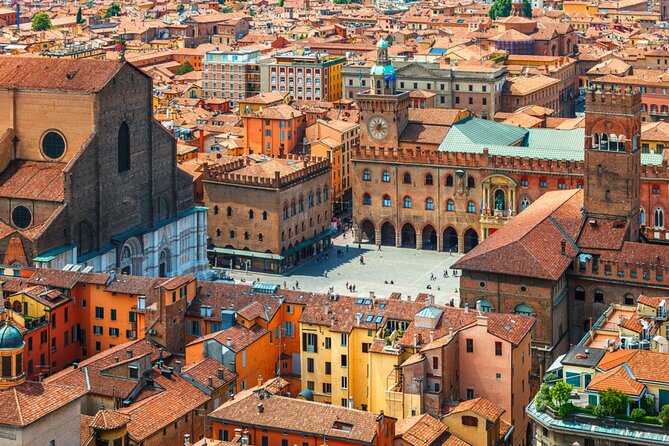
Piazza Galvani lies beside the Palazzo dell’Archiginnasio, one of Bologna’s important historic buildings. The square was once used for the silk market, and its present form developed when the Archiginnasio was built from 1563 onward.
That change tells you something useful about Bologna. Public spaces were often reshaped to frame important buildings and give them greater presence. The puzzle encourages you to look at the square as a planned setting, not just as an open patch beside a famous address.
This is a short stop in the advertised schedule, but do not rush if the architecture interests you. The surrounding walls and porticos reward a slow inspection. You may also find that crowds or current building work make a clue harder to spot. The app’s information and visual references are not always perfectly current, so use your eyes and the site itself as the final authority.
For families, this kind of stop works well. Children can search for a visual answer while adults add the historical context. Nobody needs to stand still for a long spoken explanation.
Same streets, a different puzzle:
- Open Air Escape Game in Villa Borghese !
★ 4.5 · 145 reviews - Mostra Leonardo Da Vinci: Rome Treasure Hunt Game
★ 4.7 · 140 reviews - Angels & Demons Rome Scavenger Hunt: The Illuminati Escape Game
★ 4.5 · 103 reviews - Open Air Escape Game – TRASTEVERE REVOLUTION
★ 4.5 · 89 reviews
The Quadrilateral market lanes
The route then reaches Bologna’s Quadrilateral, the old market district behind Piazza Maggiore. This is where the experience shifts from grand squares to narrow lanes and working streets.
The area has medieval roots in craft, trade, and specialized shops. Many businesses still sell related goods from one generation to the next, and some retain older interiors or signs. The streets include the characteristic small openings known as buchette, as well as old pharmacies and shops with historic fittings.
This section may be the most useful part of the quest for first-time visitors. A map can tell you where the Quadrilateral is, but a puzzle makes you look closely at its doorways, signs, and small architectural details. It also helps you understand that Bologna’s center is not only a collection of monuments. It is a place where commerce and daily life still fill the old framework.
The tradeoff is that this is an active market area. Narrow lanes can be crowded, and you may need to pause your search to let people pass. Keep your phone secure, and do not stop in the middle of a doorway while studying a clue.
Neptune’s Fountain and the public heart of town
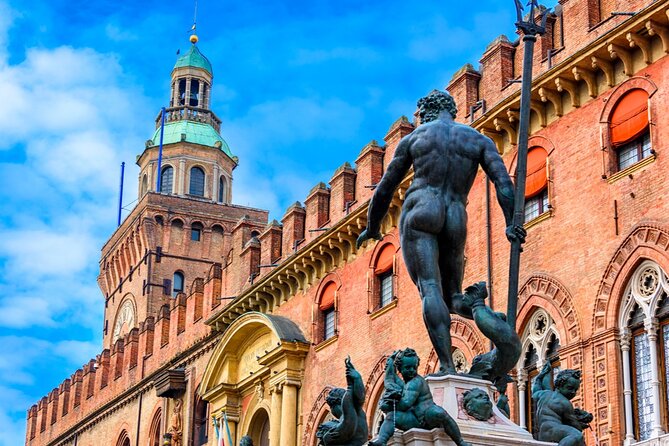
Neptune’s Fountain brings you back to a major civic sight. The fountain was completed in 1565, and the large bronze figure of Neptune was added around 1567. The statue came from an early design by Giambologna, who had also submitted a model for Florence’s Neptune fountain but did not receive that commission.
A puzzle at a famous monument can be more rewarding than simply taking a photograph and moving on. You start noticing the fountain’s arrangement, sculpture, and surrounding civic buildings. The challenge gives you a reason to examine what is in front of you.
This is another good place to take a break. Piazza Maggiore and the streets around it offer plenty of opportunities to pause, but remember that the game is self-guided. No guide is waiting for you, and there is no fixed group schedule to preserve.
If the answer seems impossible because a sign or feature has changed, do not spend too long fighting the app. Construction and altered details have caused problems on parts of the route. Try the visible surroundings first, then use any help built into the app if available.
Torresotto and Bologna’s old defensive rings
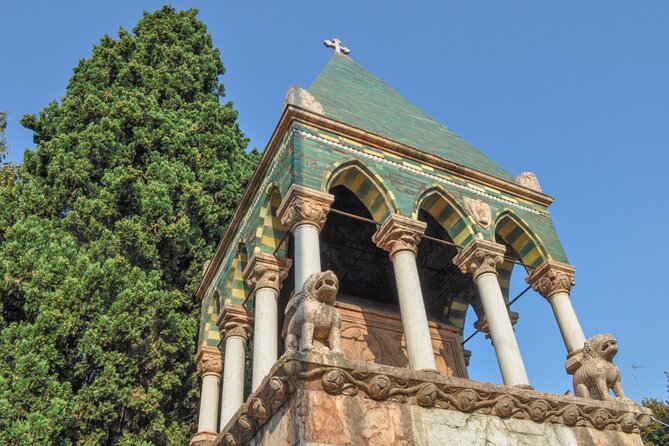
The route next points you toward the Torresotto, also known as Porta Nova. This gate belonged to Bologna’s second ring of walls, completed in 1192.
The second ring stretched about 4 kilometers and included 16 gates and two smaller posterns. Its walls were roughly 8 meters high and topped with brick merlons. Bologna was surrounded by three successive rings of walls, built over several centuries.
That is a lot of history for a small urban feature. The gate helps you picture a city that was once protected by substantial defensive lines, not just the streets and buildings you see today. The use of local selenite stone in the older wall ring also connects the defenses to Bologna’s building traditions.
I like this part because it takes you away from the most polished postcard locations. You are asked to read the city’s older structure through a surviving gate. The route may feel less direct here, and the app’s map links deserve a quick check before you set off.
Torre Prendiparte and the medieval skyline
Torre Prendiparte, also called the Coronata Tower, is one of the route’s strongest reminders that Bologna was once a city of competing tower families. The Guelf Prendiparte family built it in the 12th century for defense.
Its red brick and heavy selenite blocks give it a fortress-like appearance. Even from street level, the tower helps explain why Bologna’s skyline once bristled with private defensive buildings.
The challenge here works best if you take a moment to look at the construction rather than treating the tower as a quick marker. The materials, thickness, and vertical form matter. You do not need a separate admission ticket to complete the stop, and the route uses public spaces rather than requiring a paid interior visit.
That keeps the cost low, but it also means the quest cannot provide the fuller access or interpretation you would get from a guided tower visit. Think of this as a well-placed introduction to Bologna’s towers, not a substitute for entering one.
Piazza Verdi and student Bologna
The final stop is Piazza Giuseppe Verdi, halfway along Via Zamboni. This is the student quarter, centered around a square used for concerts, markets, street performances, social gatherings, and evening events.
Piazza Verdi shows a different side of Bologna from the medieval towers and old market lanes. It is a meeting point for students and local social life, with La Scuderia Café nearby. The square can feel informal and lively, and it gives the route a modern ending rather than finishing only among monuments.
The stop is also useful because it places Bologna’s university culture within the old center. You see how historic streets serve current residents, not only sightseers.
The stated end point is on Via Giuseppe Petroni, near Piazza Verdi. That is convenient if you want to continue into the university district or find a place to eat. It is less convenient if you expected to finish directly at Piazza Maggiore, so check the end location before planning your next reservation.
Price, app performance, and practical value
At $6.60 per person, this is inexpensive for a structured activity in central Bologna. A private group of friends or a family can share the experience without paying for a physical guide, and group discounts are available.
The value comes from the route and the prompts, not from a long spoken explanation. You are paying for a self-guided story, 14 challenges, and a reason to connect several parts of the center. If you already plan to walk through these areas, the quest adds a game layer for very little money.
The app is the main variable. It is designed to work without an internet connection after setup, which is helpful when your signal is weak or you are using limited data. Still, downloading the Questo app and getting started can be a problem. One participant could not connect or download it even with hotel internet and help from Questo.
Set up before reaching the starting point if possible. Confirm the app is installed, enter the access code, and make sure the quest opens. A charged phone matters because the route relies on mobile access rather than printed instructions.
There have also been wrong map links and clues affected by construction. The experience has a 4.1 rating from 24 ratings, which fits the overall picture: the idea works well when the technology and physical clues line up, but the experience can suffer when they do not.
Who will enjoy this Bologna quest?
I would choose this for families with children old enough to read clues, couples who enjoy small challenges, and groups of friends who want a shared activity without a guide. It also suits repeat visitors who have seen the major squares and want a reason to pay closer attention to side streets and old gates.
It is less suitable if you want a polished historical tour with a human guide, detailed explanations at every stop, or guaranteed route accuracy. It is also not ideal for a rushed schedule. The advertised 90 minutes may be enough to complete the challenges, but stops, wrong turns, photos, food, and construction can stretch the outing.
Most people can take part, the activity is near public transportation, and service animals are allowed. Since only your group participates, you can set the pace. That private format is especially helpful when children need breaks or when one person wants to stop for a coffee.
Should you book it?
Book Bologna Secrets Quest if you like exploring with a purpose, want to keep costs down, and enjoy solving clues as you walk. The route links the Two Towers, Piazza Santo Stefano, the Archiginnasio area, the Quadrilateral, Neptune’s Fountain, medieval gates, Torre Prendiparte, and the university quarter in a compact introduction to the city.
Skip it if you need a fully guided experience or if app problems would spoil your day. Before booking, make sure your group is comfortable using a phone-based game, and plan a little extra time beyond the stated 90 minutes. Free cancellation is available up to 24 hours before the start time, but changes or cancellations inside that window are not refunded.
For $6.60, I think it is a sensible way to add shape and playfulness to a Bologna walk. Just keep your expectations practical: the city supplies the best sights, while the app supplies the questions.
FAQ
Where does the Bologna Secrets Quest start?
It starts at the Two Towers in Piazza di Porta Ravegnana, 40126 Bologna.
Where does the quest end?
It ends at Via Giuseppe Petroni, 37, 40126 Bologna, near Piazza Verdi and the university district.
How long does the experience take?
The expected duration is about 1 hour and 30 minutes. You should allow extra time for breaks, photos, wrong turns, or construction affecting a clue.
Is there a physical guide?
No. This is a self-guided activity played through the Questo app, and only your group participates.
Does the game need an internet connection?
The adventure is designed to play without an internet connection, but you need to download the app and set up access before starting.
How many puzzles are included?
The experience includes 14 puzzle-based challenges connected by a story about Bologna’s mysteries.
Can I cancel for a refund?
Yes. You can receive a full refund if you cancel at least 24 hours before the local start time. Cancellations or changes made within 24 hours are not refunded.
New puzzles around Italy
- Genoa Historic Centre Quest: A Self-Guided Puzzle Adventure★ 4.0 · 3 reviews
- Treasure Hunt in Florence for Families★ 4.5 · 3 reviews
- 2-Hour Private Treasure Hunt in Florence★ 5.0 · 3 reviews
- Florence Haunted Secrets: Echoes of the Dead Exploration Game★ 4.0 · 9 reviews
- Florence Scavenger Hunt and Highlights Self-Guided Tour★ 4.5 · 3 reviews
- Private Family Tour – Uffizi Gallery for Kids★ 5.0 · 27 reviews
- Kids treasure hunt in the Boboli Garden. Private, timed entry!★ 5.0 · 2 reviews
- Florence Highlights Self guided scavenger hunt and Walking Tour★ 4.5 · 3 reviews
Self-Guided Games, head to head.


Sibiu Old Town Exploration Game and Self-Guided Tour
Read our review →

Other lists this game appears in